

 Medically reviewed by
I hope you have found the right bipolar medications for you! When I was first diagnosed with bipolar disorder it took a long time for me to fine tune my own meds.

Not all bipolar medications are created equal, and finding the right bipolar drugs for YOU may be a long and difficult journey.
Here at Bipolar-Lives.com we have had our own struggles with bipolar drugs.
We understand the challenges involved in finding – and fine-tuning – the bipolar disorder medications that are best for YOU.
We have also taken the journey and understand how difficult it can be to get the right bipolar drugs.
Don’t worry – you are NOT alone! Get the facts from someone who has tried just about all the bipolar drugs out there.
Someone who understands the REAL impact of side effects, medical expenses, and the struggle to communicate with friends, family, and doctors.
My quest for the right bipolar drugs was shorter than it is for many people, but it was still too long. I tried atypical antipsychotics (Geodon was especially disastrous, also Topamax and Depakote – a side effect nightmare) before “coming home” to lithium.
I have family members using the Lamictal and lithium combination and can see why some experts consider this to be emerging as the new gold standard in bipolar medications.
Best Bipolar Drugs?
Bipolar disorder is characterized by mood swings, and this means that the primary goal of bipolar medication MUST be mood stabilization.
1
Therefore, the best bipolar disorder medications are often mood stabilizers.
These are drugs that regulate mood swings so the extremes of depression and mania may no longer occur.
IMPORTANT:
Many of the most prescribed bipolar medications today are NOT mood stabilizers.
Some may even TRIGGER mania or depression.
The most challenging aspect can be finding the right bipolar drug for the current phase of the illness. For example, there may be a difference between what meds are required for treating an acute mood episode, versus what is required for maintenance treatment.
2 (describes different treatment strategies for different disease states)
Furthermore, episodes of depression may require a different treatment than when you are experiencing mania. Often this is done with “medication cocktails” – combinations of mood stabilizers with other bipolar approved medications such as certain antidepressants and/or anti-psychotics.
Lithium is the most researched of all bipolar disorder treatments. Studies indicate it is best for prevention of mania – BUT lithium is now known to be a WEAK treatment for bipolar depression. This is important since we usually spend more time in depression than in mania.)
First line monotherapy drugs for patients with bipolar I depression who are not currently taking an anti-manic drug are generally quetiapine or lurasidone.
6 (first line drugs in bipolar I depression) On the other hand, Lamictal is VERY EFFECTIVE for the treatment of bipolar I depression who do not respond to other medications.
6 (using lamictal in bipolar I)
Hence, a potentially effective maintenance treatment for someone with bipolar disorder and a depressive bent would be the Lamictal/Lithium combination..
In fact, the lithium/Lamictal combo is one of the most effective treatments at controlling bipolar behavior for many patients.
Purpose of Bipolar Medications

There are some other medications available that come in and out of fashion. However, our major focus will be on using mood stabilizing drugs as the first line of treatment for bipolar symptoms.
Obviously, the primary goal of taking medication is to first and foremost treat bipolar symptoms.
When a person has manic-depressive illness, there are 4 main things they need from their bipolar medication:
- Episode Prevention: You need to avoid both manic and depressive episodes. Remember, each episode you have increases the likelihood of further episodes – and failure to medicate is a major cause of relapse (the return of serious bipolar symptoms).
- Mood Control: Bipolar is a mood disorder so control is the primary goal. Therefore, mood stabilizers are your best bet for effective bipolar medication – they treat both mania AND depression – (i.e. both bipolar symptoms – as well as protecting you from future episodes.)
- Neural Protection: It has been shown that each extreme mood episode can cause damage to the brain. However, some medications help protect the brain from damage.
3
(lithium’s use and neuroprotection) - Treatment for an Acute Phase: If you are already in the grip of pronounced mania or depression, and are exhibiting severe bipolar symptoms, you need to return to a balanced mood ASAP.
These factors suggest that the traditional approach of using a proven mood stabilizer such as lithium is still the wisest approach.
(If you are resistant to the idea of mood stabilizers, check out an authoritative source on bipolar medications such as the Practice Guideline for the Treatment of Patients With Bipolar Disorder.)
Bipolar Medications to Avoid
For people with this mood disorder, it is more common to suffer from symptoms of depression than mania.
While the fallout from manic episodes can be particularly destructive, and it is the occurrence of mania that characterizes this disorder, most bipolar people will spend more time struggling with their symptoms of depression than mania.
4 (depressive symptoms predominate)
Also, research shows that depression is harder to treat than mania in bipolar disorder. Unfortunately, this is something many of us found out the hard way. Medical professionals often still misdiagnose bipolar disorder as depression.
For these reasons, many bipolar patients are given antidepressant drugs. DON’T TAKE THEM UNLESS YOU ALSO TAKE A MOOD STABILIZER AND/OR HAVE A DETAILED JUSTIFICATION FROM YOUR PSYCHIATRIST! The latest research suggests that antidepressants are either ineffective or downright dangerous if what you really have is manic-depressive illness.
5 (some antidepressants can be used, others should absolutely be avoided)
There is not any reliable evidence that supports the continuous use of an antidepressant to prevent further episodes of bipolar depression. In fact, there is a definite risk of the medication triggering a switch to mania.
SSRI drugs are NOT effective bipolar medications. However, “Benzo” antidepressants such as Klonopin, Xanax, Valium, or Ativan may be beneficial in treating anxiety and panic.
You will want to steer away from atypical antipsychotics until you have tried the traditional frontline bipolar medications such as mood stabilizers and anti-convulsant drugs. Many of them are listed for easy reference at the bottom of the page.
- An exception is Seroquel (quetiapine), which has a great track record, although it can lead to weight gain.
- Zyprexa (olanzapine) should be avoided, since it can lead to substantial weight gain and diabetes.
Although these drugs have recently become fashionable bipolar medications, and do have some research to support their effectiveness, there is a lot of debate about the conduct of the drug companies and the doctors they paid to conduct these studies.
Also, in some US states there have been lawsuits and legal settlements. There is evidence that these drugs have been pushed in inappropriate ways and have severe side effects that consumers are not suitably warned about. Zyprexa is the biggest culprit.
Abilify is popular because some believe it does not have these same weight gain problems (although it does) and there is now evidence to support its effectiveness for treating both mixed episodes and bipolar mania.
However, the latest atypical on the market – Latuda – has much milder weight gain side effects and is both unusual and very welcome since it is FDA approved for treating bipolar depression.
6 (lurasidone in bipolar depression)
YOUR Bipolar Medications
Use this section of the website to discover the truth about YOUR bipolar medications.
Learn the facts you need to discuss medication with your medical team and loved ones.
Discover the secrets to:
1. Managing side effects, especially WEIGHT GAIN by using the bipolar diet
2. Understanding the intricacies of medication combinations and how to adjust them according to whether you are stable, manic, or depressed, and
3. STABILIZING instead of over-sedating or over-stimulating.
We will be looking at:
1. Lithium (the classic mood stabilizer)
2. Depakote (mood stabilizer/anticonvulsant)
3. Abilify (atypical anti-psychotic)
4. Geodon (atypical anti-psychotic)
5. Lamictal (mood stabilizer / anticonvulsant)
6. Latuda (atypical antipsychotic)
7. Seroquel (atypical anti-psychotic)
8. Topamax (an anticonvulsant)
9. The benefits of Wellbutrin (an antidepressant)
10. Zyprexa (atypical anti-psychotic).
Remember: Medication is NOT the be all and end all of bipolar treatment options!
1
Bipolar Medications and Weight
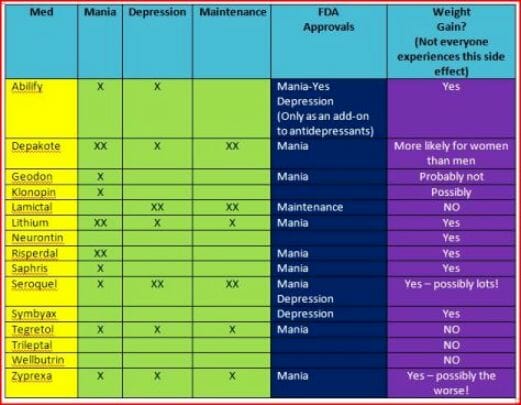
Latuda has come on the market since this table was created. Although it does have weight gain as a side effect, it is much milder than Seroquel or Zyprexa. Latuda is for treating bipolar depression – not mania or for ongoing maintenance so is probably best as an add-on to lithium or Depakote.

42 Comments
I know for a fact that Seroquel causes a metabolic disorder. I typically have a very high metabolism and stay between 100-110 lbs ( I am 5’0). On Seroquel, my weight went up to 128lbs in a very short span of time. I quit taking the Seroquel and switched over to another medicine but it took me 6-9 mos to lose the weight I had gained due to the Seroquel. A sad part about it is that gaining the excess weight can just lead to more depression if you worry about weight gain. Luckily my Dr. listened to my concern and changed my medicine. I am now on Abilify and have not noticed a weight gain with it.
Just stopping by because I’m covered with a Lamictal rash and just curious what other options my MD will likely go to so that I can understand them ahead of our next conversation. The rash is a bummer because I have been feeling so good on this particular medication. And so it goes. Just trying to find the balance between feeling good, not being a bloated fatty and being healthy!
I know this is a few months later, but what dosage were you on with the lamictal? Usually a DR. will RX a low dose and gradually increase due to the rash concerns. Maybe try trileptal?
How is your rash? What did your doctor say? I’m hoping to try Lamictal.
I would like to know more about patient experience with lamictal. Latuda sent me into a very dark depression after doing well for 8 weeks on it. My dr suggested lamictal as it is a mood stabilizer and not an antipsychotic.
I understand your pain. I was on lamictal for 2 months and I finally felt like my old self for the first time in at least 2 years. However, I also lost a third of my hair, my nails stopped growing and I started to develop cysts and rashes all over my body! Had to stop it and now am about to try latuda. I have tried Abilify, Seroquel, Depakote and Lamictal. Praying that my journey is over!
I had adverse affects before feeling the benefits of Lamictal. I was prescribed Latuda but it was too expensive. I’m now on Geodon(ziprasidone) 40mg once a day at night. Don’t feel much different. Hope this helps some. Good luck, we’re on this journey TOGETHER!!
ive been taking lithium, abilify, clonazepam, and ambien and its helped the mania but im still having delusions. am i still even bipolar?
Ive tried lithium and am currently on lamictal… Lately i feel way out of control. I was upped to 150 milligrams of lamictal and now i get dizzy and still have manic issues… I can be severly depressed and in my head one day than over talkative and excited the next and not even remember how i blew 100s of dollars… Litium made me feel sick and lethargic. Does anyone have any med combos i can run by my dr?
Hi Im writing because I have mild bipolar and dont want to go through a naturopath to treat it but still want to treat it in a more holistic way before taking mood stabilisers or would you recommend to just go straight for a stabiliser.as.I was thinking that would kind of fix it anyway? a holistic based one or not I try to eat right so I thought just try a stabiliser.. what is the best one? And what are the differences
My partner is now on clonazepam
Does anyone know of a bipolar medication that doesn’t cause extreme drowsiness or feeling tired all day long?… please help!
I have been taking Latuda for about 6-9 months, while still experiencing swings but far less than many of the others (Seroquel, Abilify). I have also been on Neurontin for nearly 15 years and think it’s what’s kept me alive all this time, so it’s unfortunate it gets no score on the chart. Since I’m still experiencing swings, mainly mania, my doctor is adding Lamictal to my Latuda, Neurontin, and Wellbutrin “cocktail”. She said we’ve tried so many over the past several years to avoid lithium, this is a last resort. Next step is lithium. Has anyone taken a similar cocktail? I have thyroid issues on top of all the bipolar issues, and my thyroid was high so weight gain isn’t a good gauge for me because I’ve lost weight but attribute it to the thyroid level so being off.
Hi! After 15 years of self harm, alcohol abuse, ups and down with bouts of severe suicidal depression and highs that leads me to overachievement, productivity, goal-oriented projects, etc. I was finally diagnosed with Bipolar 2. I had been put on a stimulant to control my hyperactivity.,. and it sent me into a full-blown mania. So that was a blessing and a mess. My doc gave me trileptal and now abilify to help. I take 150 trileptal in the morning and 300mg at night and 5mg of abilify in the morning. so far, so good. I haven’t had an up in a ver long time, however I feel too low (which is why they added the abilify). The abilify causes me much to feel restless inside. We upped the trileptal at night and it seems to help balance it out. I sleep better, but still feel weird inside. Meds are a hard life. Trileptal has been the only thing that has ever helped calm my anxiety and also get rid of most of my sensory issues. This has never been a thing, ever. So it is a much needed relief. I haven’t had hardly any probls with trileptal side effects.
Does the combination of Wellbutrin and seroquel can unstable moods? Currently on both and am unable to control outbursts of laughter and/or crying?
In 2008 I had to check into a state hospital for help with depression. I was diagnosed with Bipolar II and prescribed a 8 pill cocktail each day. One year passed and I was just in a daze on the couch. I slowed down taking all the meds until I was free from all. The bad was I was back where I started depressed. Finally with no insurance I found a new clinic with a Nurse practitioner and her husband was a doctor at a Dallas hospital. SHe asked if I would try Seroquel and I was getting it free from astrazeneca. It was a miracle drug and was finally sleeping again to. Years went by and the free program ended. The clinic closed there doors and I could not get it free anymore either. Spent months slowing down to 50mg a day till I almost ran out again. Well insurance on my doorstep once again and back on 300mg once a day. I am now 62 years old and insurance has left me again in 2018 coming up. I have already started to come down again to 50mg a day and wow, it does not feel so good and I spend all my time in bed everyday. I have had to avoid people amnd phone calls as I am getting a bad temper each day. 2018 does not look pretty to me and all I can do is pray to god for help.
i so sad to hear that, how are you now? wish i can help, it is ironic that Seroquel is cheap in Aust. 300mg/day it cost about $5 p/month for your medication, this is pharmaceutical benefit for everyone here, how much does it cost at your place? your govt. should do something about it. keep hanging there Rick, find something to do, concentrate on doing thing or work will help with your depression, i always remember the psychiatrist said to me these feelings(depression/anger..) come and go, come and go, try hard to fight with it, it will go away. i pray for you too
I’ve been taking Lamotrigine and Fluoxetine for a bit now, that seems to be the only cocktail that had worked for me and I’ve been on a number of them including lithium and celexa and other antidepressants. I also take Topamax however those were prescribed from a neurologist for migraines not a mood stabilizer. However, neither doctor wants to touch it the dose amount cause it seems to be working a bit of each. My migraines, for when I’m taking all meds as suppose to and my bipolar when i don’t manges my bipolar for a very short amount of time till I recall to take my meds.
Regardless of the cocktail of medication we have to take, it is give or take unfortuntely. It’s up to us to know about ourselves and our bodies, then we have to educate ourselves about the illness. The more we know, the better we can help treat ourselves and step up and take control of the illness and not let the illness take control of you.
Has anyone suffered muscle cramps, specifically in the upper arms from taking Lamictal? The pain is unbearable at times.
I’ve tried everything for mood stabilization but I seem to get very aggressive and angry on most, and epilum made me feel depressed all the time even though i take lexapro for depression. with doctors advice am going to go off epilum slowly and increase seroquel – i have gained a huge amount of weight from going on seroquel originally 7 years ago but just want to feel stable again, and am tired of waking up every day dreading the day ahead. even though the weight gain was very distressing at first, i am hoping that seroquel will stop me going manic and keep the depression away. i found lithium dreadful!
Antidepressants can cause the anger and mania. I would try to get off the antidepressant. Good luck!
I take seroquel at night I have to because it makes me so sleepy. I need something I can take during the day to keep me equaled out. I don’t know what to do.
For me, Lamictal is the gold standard for mood stabilization. It began to work immediately when I started it eight years ago. No more ‘deep, deep’, depressive episodes where I could barely get out of bed. Does it cure depression, suppress hypomania? No. For me, dealing with these remnants of bi-polar is an ‘inside job.;: daily hour of exercise, meditation, moderate attention to diet (not a fanatic, life’s too short tho I have heart disease). I did develop am “out of range’ mood recently and my pdoc put me on Latuda. It was a miracle drug for about three days, then came stomach problems and sleep problems. So I went off. A month or so later, another down mood occurred and I went back on Latuda again because it switched me out of depression so quickly (24 hours) it was worth another try. Again immediately felt better for several days, then unpleasant symptoms and return of low mood. I am thinking of using Latuda PRN when I need a quick mood shirt. It’s that effective for me. This is agreat article which all bi-polar patients should read. So concise, based on science and clearly written. Kudos to the author(s). Full disclosure: I also take 1mg of Klonopin daily for anxiety which helps enormously. I plan to stay one it, despite warnings, for the rest of my life. I’m 76 and don’t take my life for granted. If Klonopin significantly improves the quality of my life, I couldn’t care less about the warnings. In fact, I’ve done research and found dozens of people in the 70s and 80s who’ve taken it for years with no adverse mental effects (memory, et al).
The lithium was a great help in 1998. Lamictal was helpful also in 2000. In Sept 2017, the Lamictal ceased being effective. I had every side effect but the rash. I became manic in Jan 2018. In mid Feb, I discontinued the Lamictal. 3 weeks later, the side effects are almost gone & I feel so much better overall! But now I am rapid cycling (cycling can be 15 mins to 1 day). Have tried Ambien, Zyprexia, Seroquel and many others in past years. Not yet tried Latuda. Dr wants me to try Trilptal but listed side effects are Extreme Drowsiness AND all the same side effects as Lamictal. I am so tired of being discounted and ignored!!!!!!!! Often the drugs make me feel worse physically & mentally. The side effects make it impossible to function. Society finds it unacceptable for me to take my life yet dooms me to a life of physical & mental sufferring without end.
Trust Lithium in the long term. Find your level and have regular blood tests. Step by step, no running with different medication ideas. Most important is eight hours sleep a night. If you cant control this then seek medication for sleep. I proffer natural medicines and there are many. Do not give up!
After finally being diagnosed bipolar at age 63, I was prescribed Lamictal and Latuda. I was diagnosed by a forensic psychiatrist who also tested my genetics for drug interactions. I was likewise found to have the MTHFR gene mutation and had not been fully assimilating folic acid all my life. With the combination of Lamictal, Latuda and prescription folic acid my mind has become calmer. I miss being super outgoing but having a quiet mind is more important. Latuda and folic acid were the new medicines that sealed the deal for me. Just wanted to share.
What is the best anti-psychotic and depression combination that does NOT cause weight gain?
Mind over matter
Abilify is wonderful! It has changed my life. I have had weight gain, but I have to be in charge of my choices.
I used lithum for 34 years as result iam now in kidney failure .
This 74 year old Canadian male been successfully on Lithium Carbonate [dont forget to do regular blood serum tests 0.40 – 0.80 therapeutic range] since diagnosed in 1989. My psychiatrist and medical doctor were on board for a switch to Seroquel [800 mg daily @ night]. Apparently as one gets older creatine levels can increase so one doesn’t want kidney or liver problems.I should also mention that I had 14 rounds of ECT at the Homewood Health Center near Toronto. The brain reboot did a world of good. My wife says that I am far less irritable and angry. I also participated in 2×12 sessions of CBT which I wholly endorse. I belong to a support group { MDSGG.CA} as well which is very instrumental as a part recovery.
KEEP UP THE GOOD WORK ON THIS WEBSITE
I receive my medical care from the VA, so I don;t have a choice of what kinds of medicine I take. I take Lithium at night, and Wellbutrin during the day.
What’s worse, being judged by society for being bipolar or feeling ashamed and being judged for being a bloated fatty by someone who also suffers from being bipolar?
This has been a very helpful forum.
I’m taking lithium, lamictal, escalipram, vistoril, latuda. Very tired for many,many months. Will undertake ECT’s in a month.
Very tired of being very tired–not getting anything done, especially what is important to me!
“Buckshot”
I’ve been taking Venlafaxine for more than a year. Although it seemed to work for me, the last few months i’ve experienced more vivid dreams and moods swings again. Also rash, which comes and goes.
The last 2 or 3 months I have had episodes (a couple of times a day) when I have no energy all of a sudden, have to stop doing what I’m doing and rest.
Would that be caused because I have been taking it for so long?
…..Lamictal, which I was taking at the beginning of my treatment, with Venlafaxine, gave me a severe rash and I had to stop it!
I use Sodium Valproate, which category does it fall into?
I’m bipolar 1 and have used lithium and haldol, both made me groggy and desinterested; thereafter I used Olzanzipine, through which I gained a lot of weight; at the present I’m using Aripiprazol and Carbamazepine without any side effects.
I’ve been taking venlafaxine for 8 years and struggled with lots of symptoms over the yrs. the lows are so very low! The highs are up cleaning for over 24 hrs n not able to stop and spending all money I have. Going through tribunal at the minute, as it doesn’t stop you working in the UK apparently! Very unhappy, severe anxiety for last 2 weeks, unable to sleep. Really not enjoying life but no talk of different meds with my Dr or Psychiatrist. I want a life where I’m able to live and work not just exist. Sooooo tired of bipolar 2. ????
My comment is about Abilify. I believe it is a very effective drug but be careful and observant of yourself. I developed tardive dyskenesia in mouth jaw. Thankfully my doctor noticed early and took me off Abilify. My sysmtoms went away after about six months but 6% of patients taking Ablify develop this. Some a lot worse than I. Its in the warning but of course not emphasized! so be careful ok?
I’ve been taking Latuda and Lamictal for 6 months now.What it’s done for my bipolar mania and my psychosis has been phenomenal. No complaints there.
However I’ve suffered some of the worst side effects beyond description. Restlessness, pounding heartbeat, surging waves of electricity, extreme emotions of fear and terror, extreme feelings of weakness and tremors. I was RX Cogentin and praise God it took almost all of it away. What remains is the weakness and a cloud of energy that crawls up my back and disables me. Increasing the Cogentin doesn’t do anything. And me and the doc agree it’s umwise to change meds at this stage.
Has anyone else suffered this? Has anyone overcome It? I have a blue collar job and I need my strength and vitality back.
I am bipolar II and have been on various cocktails over the last 15 years. My base cocktail is lamotrigine (200mg twice a day) and Pristiq. The variable has been whatever we augment with when the depression gets unbearable. I started taking the activated folate which has helped a lot but seems to be activating at full dose. We recently added wellburtin sr and I am a zombie. Depression is gone and have actually lost weight but I can barely form sentences. I am scared to make a change to my base but may be at that point. How do you all deal with that fear? Changing meds is terrifying to me.