
Suspension Bridge Effect: What It Is, Psychology Behind It, and How It Influences Love

Medical Reviewer: Laura Athey-Lloyd, Psy.D.Clinical Note: This article explores a psychological phenomenon regarding attraction and arousal. It is for educational purposes and does not replace professional relationship counseling or therapy.
Have you ever wondered why horror movies or roller coasters are such popular first date choices? It isn’t just about the thrill of the activity; it’s about what that thrill does to your heart—and your brain. In psychology, we call this the suspension bridge effect.
In my clinical practice, I often hear patients describe a “whirlwind romance” or “intense chemistry” that felt undeniable in the moment. They describe a racing heart, sweaty palms, and a feeling of breathlessness. Interestingly, these are the exact same physiological symptoms of fear or anxiety. The suspension bridge effect suggests that our brains sometimes get these wires crossed, mistaking a terrifying situation for a romantic spark.
Understanding the suspension bridge effect’s meaning is crucial, not just for dating, but for understanding how we process emotions. It challenges the romantic notion that love is purely a matter of the heart, showing us that it is often a matter of context, adrenaline, and interpretation.
What Is the Suspension Bridge Effect?
To understand the suspension bridge effect, we have to look at how we define feelings. We often assume we know exactly why we feel a certain way. If we are crying, we must be sad. If we are shaking, we must be scared. However, human emotion is messy.
What is the suspension bridge effect? The suspension bridge effect is a specific type of misattribution of arousal. It occurs when a person experiences physiological arousal (like increased heart rate) from a high-anxiety environment and incorrectly attributes that excitement to the person they are with. Instead of thinking, “I am scared of this bridge,” the brain thinks, “I am incredibly attracted to this person.”
You might also hear this referred to as the suspended bridge effect or simply the bridge effect in psychology. Regardless of the name, the mechanism is the same: the environment tricks the brain into feeling attraction.
Snippet Box: What is the suspension bridge effect? The suspension bridge effect is a psychological phenomenon where individuals misinterpret physiological arousal—such as fear or anxiety caused by a dangerous environment—as romantic or sexual attraction toward a nearby person.
Suspension Bridge Effect Psychology Explained

The suspension bridge effect psychology rests on a foundational concept called the Two-Factor Theory of Emotion, proposed by Schachter and Singer in the 1960s. This theory argues that emotion requires two things:
- Physiological Arousal: Your body reacts (heart beats faster, palms sweat).
- Cognitive Labeling: Your brain looks around the environment to explain why the body is reacting.
The Mechanics of Misattribution
This is where the misattribution of arousal theory comes in. If the source of the arousal is ambiguous, the brain grabs the nearest plausible explanation.
Imagine you are on a date.
- Scenario A: You are sitting in a quiet coffee shop. Your heart rate is normal. You look at your date and decide if you like them based on conversation.
- Scenario B: You are skydiving. Your heart is pounding at 140 beats per minute. You look at your date. Your brain asks, “Why is my heart pounding?” Even though the parachute is the real reason, your brain might unconsciously decide, “Wow, this person is thrilling!”
In my work with couples, I often have to help them distinguish between “trauma bonding”—where high-stress situations create a false sense of intimacy—and genuine, safe connection. The suspension bridge theory highlights how easily our biological wires can get crossed.
Suspension Bridge Effect and Love
Is it real love, or is it just gravity? When discussing suspension bridge effect love, we have to tread carefully. High arousal can certainly jumpstart attraction, but it cannot sustain a relationship.
The Role of “Chemistry”
Many people confuse anxiety with chemistry. I’ve seen patients who grew up in chaotic households and now find stability “boring.” For them, the suspension bridge effect in relationships is a comfortable baseline. They might subconsciously seek out partners who make them feel “on edge” because their brain interprets that anxiety as passion.
However, the suspension bridge effect, meaning in a healthy context,t is about amplification. If you already find someone somewhat attractive, a scary movie or a hike up a steep mountain can amplify that feeling. It acts like a volume knob, turning a “maybe” into a “definitely.”
Does it create love from thin air? No. If you are on a suspension bridge with someone you find fundamentally unappealing or unsafe, the adrenaline will likely just make you feel more annoyed or eager to get away from them. The effect requires a baseline of potential interest to work.
Suspension Bridge Effect Examples in Real Life
You don’t need a swaying bridge to experience this. Suspension bridge effect examples are everywhere in modern dating and entertainment.
The Roller Coaster Date
This is the classic suspension bridge effect example. The drops, the screams, and the physical closeness create a cocktail of dopamine and adrenaline. When you get off the ride laughing and shaking, you often feel an intense bond with the person next to you.
The Horror Movie Night
Watching a scary movie triggers the fight-or-flight response. You jump, you grab each other’s arms, and your heart races. This shared “survival” experience mimics intimacy.
Public Speaking or Performance
I once treated a musician who fell in love with every duet partner he had. The stage fright and the rush of performance created a massive spike in arousal that he consistently mislabeled as a romantic connection.
“Adventure Dating.”
Rock climbing, escape rooms, or axe throwing all rely on the bridge effect. They introduce a controlled level of stress (eustress) that helps break the ice and artificially heighten the sense of connection.
High-Stakes Work Environments
We often see workplace romances bloom in high-stress jobs like emergency medicine, law enforcement, or investment banking. The constant “high alert” state can bond colleagues together rapidly, sometimes confusing professional camaraderie with romantic love.
Does the Suspension Bridge Effect Really Work?
Since Dutton and Aron’s original 1974 study, researchers have scrambled to replicate the findings. The question remains: Does the suspension bridge effect really work outside of a specific bridge in Canada?
The short answer is yes, but with caveats. In psychology, we call this the misattribution of arousal theory. Subsequent studies have shown that it isn’t just fear that triggers this effect. Any form of high arousal—whether it’s exercise, watching a comedy, or even anger—can spill over and intensify sexual attraction.
However, there is a crucial limitation. The suspension bridge theory generally only works if there is already a baseline of attraction or neutrality. If you are on a scary bridge with someone you find repulsive or annoying, the fear won’t make you love them.
In fact, it might make you dislike them more. The arousal amplifies the dominant emotion. If the dominant emotion is “Get me away from this person,” the adrenaline will make you run faster, not fall in love.
Self-Suspension Bridge Effect
While the classic study focused on external triggers (a bridge), I often see a self-suspension bridge effect in my clinical practice. This happens when the “threat” comes from inside your own mind.
Many people with anxiety sensitivity (a fear of bodily sensations) are prone to this.
- The Scenario: You meet someone new. You feel a flutter in your chest.
- The Misinterpretation: You think, “I must be nervous because I like them!”
- The Reality: You might actually just be anxious because you have social anxiety, or you had too much coffee.
This internal misattribution of arousal is common in people with insecure attachment styles. An anxious attacher might mistake the panic of “Will they text me back?” for “passion.” A securely attached person might interpret a calm, steady heartbeat as boring, missing out on a healthy partner because there was no “bridge effect” drama.
Suspension Bridge Effect vs General Anxiety
Distinguishing between the uspension bridge effect vs general anxiety is vital for mental health.
- The Suspension Bridge Effect: It is situational. The arousal spikes during the scary movie or roller coaster, then fades into a “glow” directed at the partner. It feels exciting.
- General Anxiety: Is chronic. The arousal (racing heart, tension) is present regardless of the partner. It feels draining.
If you find yourself constantly feeling “butterflies” (nausea) and a racing heart around a partner without a rollercoaster or bridge involved, that might not be love. That might be your body signaling that you don’t feel safe. In therapy, we work to untangle these wires. We want excitement to be the cherry on top, not the entire sundae.
How the Suspension Bridge Effect Influences American Dating Culture
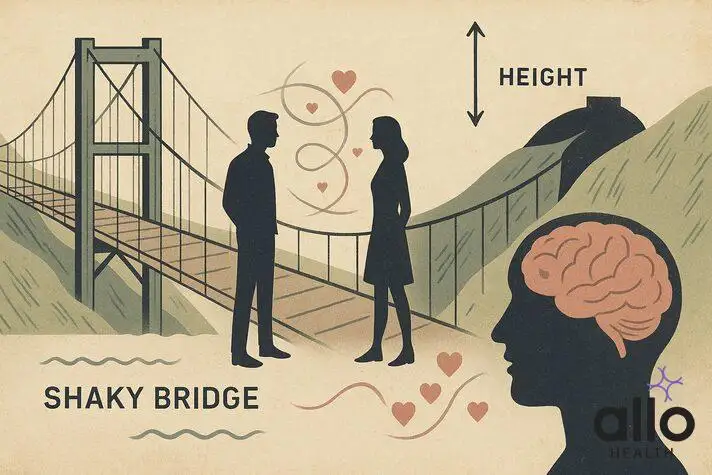
The suspension bridge effect has deeply influenced how suspension bridge effect american lives and dating norms.
Historically, dating was often about “courting” in safe, controlled environments like a parlor or a diner. Today, American dating culture is obsessed with the “spark.”
- Reality TV: Shows like The Bachelor artificially create the suspension bridge effect. They put couples in helicopters, on bungee jumps, or in high-pressure competition. This manufactures a rapid, intense bond that often collapses when they return to the “boring” real world.
- The “Adventure Date”: Dating apps and magazines constantly recommend “unique” first dates—axe-throwing, ghost tours, or hiking. This is an unconscious attempt to harness physiological arousal to hack the chemistry equation.
We have moved from asking “Do we share values?” to “Do we have electricity?” While exciting, this shift can lead people to overlook red flags because the adrenaline is too loud to ignore.
Common Myths About the Suspension Bridge Effect
Despite its popularity in pop psychology, there are several myths we need to debunk.
- Myth 1: It guarantees love.
- Fact: It only influences initial attraction. It cannot create love where there is no compatibility.
- Myth 2: It is a form of manipulation.
- Fact: While pick-up artists might try to use it, it is a natural psychological mechanism. Most couples stumble into it accidentally.
- Myth 3: It only works on men.
- Fact: The original study focused on men, but subsequent research shows women are just as susceptible to misattributing arousal.
- Myth 4: It works every time.
- Fact: If the fear is too intense (terror), the person will focus solely on survival, not romance. There is a “Goldilocks zone” of arousal.
Mania as an Internal Suspension Bridge
For individuals living with Bipolar Disorder, the suspension bridge effect is not just an external experiment; it can be an internal reality. During a manic or hypomanic episode, the body is flooded with adrenaline and dopamine. This creates a sustained state of high physiological arousal—a racing heart, sleepless energy, and heightened senses.
Just like the men on the Capilano bridge, a person in mania often misattributes this internal biological storm to the people around them. This is why new relationships formed during mania often feel like “destiny” or intense “soulmate” connections. The brain mistakes the symptoms of the episode (arousal/intensity) for profound romantic chemistry. This mechanism significantly drives hypersexuality and impulsive relationship choices. Recognizing this “internal bridge” is crucial. It helps patients distinguish between a genuine connection and the false intensity fueled by a mood episode.
Frequently Asked Questions
What is the suspension bridge effect?
The suspension bridge effect is a psychological phenomenon where people mistake the physical symptoms of fear or high arousal (like a racing heart) for romantic or sexual attraction to someone nearby.
What is the bridge effect in psychology?
It is another name for the same phenomenon. It refers specifically to the Dutton and Aron (1974) study conducted on the Capilano Suspension Bridge, which demonstrated the misattribution of arousal theory.
What did Dutton and Aron find?
They found that men who crossed a scary, swaying suspension bridge were more likely to call a female interviewer and write romantic stories than men who crossed a safe, sturdy bridge. This proved that fear can amplify attraction.
Does the suspension bridge effect make you fall in love?
No. It can spark attraction or intense infatuation, but it cannot create genuine love. Love requires trust, shared values, and time—things that adrenaline cannot fake.
Is it just misattribution of arousal?
Yes, the suspension bridge effect is the classic example of misattribution of arousal. The brain labels the physical “rush” of the environment as “passion” for the person.
Can anxiety be mistaken for attraction?
Absolutely. Many people confuse the “jitters” of anxiety with the “butterflies” of love. This is why trauma bonding or tumultuous relationships can feel so addictive; the anxiety mimics high-stakes passion.
Does it work in long-term relationships?
Yes! This is actually a great tool for long-term couples. Doing something new and exciting (like taking a dance class or going zip-lining) can re-ignite the spark by introducing fresh physiological arousal into the relationship.
Conclusion
The suspension bridge effect is a fascinating reminder that our emotions are not always what they seem. Our brains are constantly trying to make sense of a loud, fast-paced world, and sometimes they grab the wrong label.
Whether you are planning a first date or trying to understand a past “whirlwind” romance, knowing the psychology behind the suspension bridge effect gives you a superpower. You can enjoy the rush of the roller coaster, the horror movie, or the high-stakes date—but you can also step back and ask: “Is it the person, or is it the adrenaline?”
True connection stands on solid ground, even after the shaking stops.
References:
Related Posts




Subscribe to Our Newsletter
Get mental health tips, updates, and resources delivered to your inbox.
MORE from Author
Read More In my practice as a clinical psychologist, I often observe that the difference between a patient who crumbles under pressure…
- We all have "up" days and "down" days. Perhaps you feel energized after a promotion or sluggish on a rainy…


 To define bipolar disorder accurately, we must look at it as a chronic mood dysregulation condition. In psychology and medicine,…
 To answer whether bipolar fits the bill, we first have to define what a neurodivergent person actually is. The term…

Are you looking for a Therapist?
Connect with qualified mental health professionals who understand
bipolar disorder, mood changes, and emotional challenges.
Private • Supportive • Confidential