
Bipolar Disorder Quiz: What It Can Tell You—and What It Can’t

Medically reviewed by Carolina Estevez, Psy.D Updated Date: February 2, 2026
If you’ve found yourself searching for a bipolar disorder quiz, you are likely looking for an anchor in a sea of emotional turbulence. Perhaps your moods feel less like a simple reaction to life and more like an unpredictable force of nature. You might be asking, “Do I have bipolar disorder?” or “Why do I feel so high one week and so low the next?”
The first thing you need to know is that a bipolar test or bipolar test quiz is an incredible tool for self-awareness, but it is not a final answer. What is a bipolar disorder quiz in the clinical sense? It is a structured screening instrument—a “red flag” system—designed to help you and your doctor identify patterns that might otherwise stay hidden. While a quiz can identify the symptoms, only a licensed psychiatrist or psychologist can provide a formal bipolar disorder diagnosis.
This guide is designed to walk you through the most reliable screening tools, clarify the different types of the disorder, and help you transition from an online “gut check” to a professional clinical evaluation.
What Is Bipolar Disorder?
To understand the results of a bipolar disorder quiz, we must first define bipolar disorder correctly. Many people assume it simply means “having mood swings.” However, the bipolar disorder meaning is much deeper: it is a condition where the brain’s internal regulatory system for energy and mood “breaks.”
In a healthy brain, moods fluctuate within a manageable range based on external events. In a brain with bipolar disorder symptoms, the mood shifts are often disproportionate or entirely disconnected from life events. These shifts occur in “episodes”:
- Mania: A period of at least seven days where a person feels “on top of the world,” requires very little sleep, and may engage in risky behaviors.
- Hypomania: A “lesser” version of mania (lasting at least four days) common in Bipolar II, where the person is highly productive and energetic but hasn’t lost touch with reality.
- Depression: A crushing low characterized by hopelessness, physical fatigue, and sometimes suicidal ideation.
Because bipolar symptoms can look very different from one person to another, it remains one of the most frequently misdiagnosed conditions in psychiatry. This is why a targeted bipolar screening quiz is so valuable—it asks the questions you might not think to ask yourself.
Signs of Bipolar Disorder: When Should You Take a Quiz?
Most people don’t go looking for a symptoms of bipolar disorder quiz when they are feeling “normal.” Usually, curiosity is piqued during or after a significant mood shift.
Common Early Warning Signs
You might consider taking a quiz if you notice these signs of bipolar disorder quiz markers:
- The Sleep Marker: You go 3–4 days with only 2 hours of sleep per night, yet you feel more energetic than ever.
- The Productivity Burst: You suddenly start five new businesses, clean your entire house at 3 AM, or spend a month’s rent on a “new hobby.”
- The “Leaden” Depression: You feel like your body is made of lead, and you can’t even find the energy to brush your teeth.
- Pressured Speech: Your friends tell you they “can’t get a word in edgewise” because you are talking so fast.
When a Self-Test Makes Sense
Taking a free bipolar disorder quiz makes sense when you recognize a cycle. If you feel like your life is a series of “rebuilding phases” after “destructive phases,” a quiz can help you see if those phases align with Bipolar I or Bipolar II. Could You Have Bipolar Disorder? Key Symptoms to Watch For include a family history of the illness and a tendency to have “mixed episodes” where you feel wired and depressed at the exact same time.
What Is a Bipolar Disorder Quiz?
There is often confusion about what a bipolar disorder quiz test actually “tests.” In a clinical setting, we use validated instruments like the Mood Disorder Questionnaire (MDQ) or the Hypomania Checklist (HCL-32).
What is a bipolar disorder quiz intended to do?
- It measures “Symptom Clusters”: It looks for groups of symptoms that happen at the same time.
- It measures “Functionality”: It asks if these moods cause problems in your marriage, job, or legal status.
- It measures “Duration”: It distinguishes between a “bad day” and a “clinical episode.”
What it does NOT measure:
- It cannot measure brain chemistry.
- It cannot “confirm” the diagnosis. Many people score high on a bipolar screening quiz because they are actually experiencing a reaction to a drug, a thyroid issue, or intense trauma (PTSD).
Free Online Bipolar Disorder Quizzes
The internet is flooded with options, but not all are created equal. If you are looking for a bipolar disorder quiz free & no sign-up, you should prioritize those that use clinically validated questions.
Common Screening Tools
- The MDQ: This is the “gold standard” for a free bipolar disorder quiz. It focuses on 13 “Yes/No” questions about mania. If you answer “Yes” to 7 or more, and those symptoms happened at the same time and caused problems, you have a positive screen.
- HCL-32: This is a more nuanced bipolar quiz free tool. It is better at catching Bipolar II (hypomania) than the MDQ, which is geared toward Bipolar I (full mania).
Quick & Short Bipolar Quizzes
Many platforms offer a quick bipolar test consisting of only 5–10 questions. While these are great for a “gut check,” they lack the depth to differentiate between bipolar and other conditions. A bipolar disorder quiz pdf or printable version is often the most useful, as you can fill it out in a calm moment and bring it to your physician to provide “objective” data.
Popular Bipolar Quizzes Online
Where you take your quiz matters for the quality of the feedback you receive.
Bipolar Test on IDRlabs
The bipolar test IDRlabs provides is one of the most popular in 2026. It uses a “spectrum” approach, showing you a “spider web” chart of your symptoms.
- Pros: It visualizes how “grandiosity” relates to “depression.”
- Cons: It can be overly clinical and may lead people to believe they have the disorder based on a graph, rather than a conversation.
Educational Platforms (Quizlet)
You may find a bipolar disorder quizlet used by psychology students. These are great for testing your knowledge of the disorder (your Bipolar IQ), but they are not designed to test your symptoms.
Bipolar Disorder Quiz on Reddit & BuzzFeed
Search terms like bipolar disorder test free reddit or bipolar disorder quiz buzzfeed are common.
- Reddit: Community-led “quizzes” can be helpful for hearing real-life experiences, but they can also be “echo chambers.”
- BuzzFeed: These are strictly for entertainment. Do not make medical decisions based on a pop-culture quiz.
“Do I Have Bipolar Disorder?” Quiz Searches Explained
It is a common psychological phenomenon to keep searching for do i have bipolar disorder quiz free over and over. This is often “reassurance seeking.”
If you find yourself constantly asking “how do you know if you have bipolar disorder quiz” or “how to know if you have bipolar disorder quiz,” it is a sign that your subconscious already knows something is wrong. People without a mood disorder rarely spend hours taking a do you have bipolar disorder quiz. If you feel the need to keep “confirming” your results online, the most productive next step is to stop taking quizzes and start talking to a professional.
Bipolar Disorder Quizzes for Specific People

Bipolar disorder does not look the same in a 15-year-old as it does in a 45-year-old. When searching for a bipolar disorder quiz for adults versus a bipolar test for teens, the questions must change to reflect developmental stages.
Bipolar Quiz for Teens & Children
A bipolar disorder quiz for teens focuses heavily on “emotional volatility” and “disruptive energy.” While adults might express mania through financial spending, a teen might express it through extreme “clowning” in class, sudden sexual promiscuity, or a total refusal to sleep.
“Does My Child / Mom / Friend Have Bipolar?” Quizzes
Many people search for does my child have bipolar disorder quiz or does my mom have bipolar disorder quiz. These are “observer-rated” screens. If you are taking a does my friend have bipolar disorder quiz, look for these red flags:
- Have they stopped sleeping but seem to have endless energy?
- Are they making grandiose plans that are physically or financially impossible?
- Do they have “bipolar rage”—sudden, intense anger that seems to come out of nowhere?
Clinical Caution: You cannot diagnose someone else with a quiz. However, sharing your observations based on a childhood bipolar disorder quiz with a pediatrician can be the catalyst for getting them the help they need.
Bipolar vs. Depression, ADHD, and BPD Quizzes
The biggest danger of taking a “stand-alone” bipolar disorder quiz is that many symptoms overlap with other conditions. This often leads to misdiagnosis.
Bipolar vs. Depression Quiz
If you take an am i bipolar or depressed quiz, the focus shifts to your “baseline.” People with unipolar depression stay low. People with bipolar have “windows” of high energy. If you’ve ever felt “too good” or “dangerously wired,” it points toward bipolar.
Bipolar vs. ADHD Quiz
An am i bipolar or ADHD quiz is one of the most common searches in 2026. Both involve distractibility and high energy.
- ADHD: The high energy is constant and usually starts in childhood.
- Bipolar: The energy comes in “episodes” that represent a clear change from the person’s normal self.
Bipolar vs. Borderline Personality Disorder (BPD) Quiz
In an am i bipolar or borderline quiz, we look at the “triggers.”
- Bipolar: Moods are driven by internal biology (sleep, seasons, chemistry).
- BPD: Moods are driven by external relationships (fear of abandonment, conflict).
| Feature | Bipolar Disorder | ADHD | Borderline (BPD) |
| Energy Levels | Episodic (Highs/Lows) | Constant Restlessness | Reactive to Stress |
| Sleep Needs | Decreased (not tired) | Trouble falling asleep | Varies with emotion |
| Relationships | Mostly stable between episodes | Can be strained by impulsivity | Intense and unstable |
| Typical Treatment | Mood Stabilizers | Stimulants | Therapy (DBT) |
Which Type of Bipolar Disorder Might You Have?
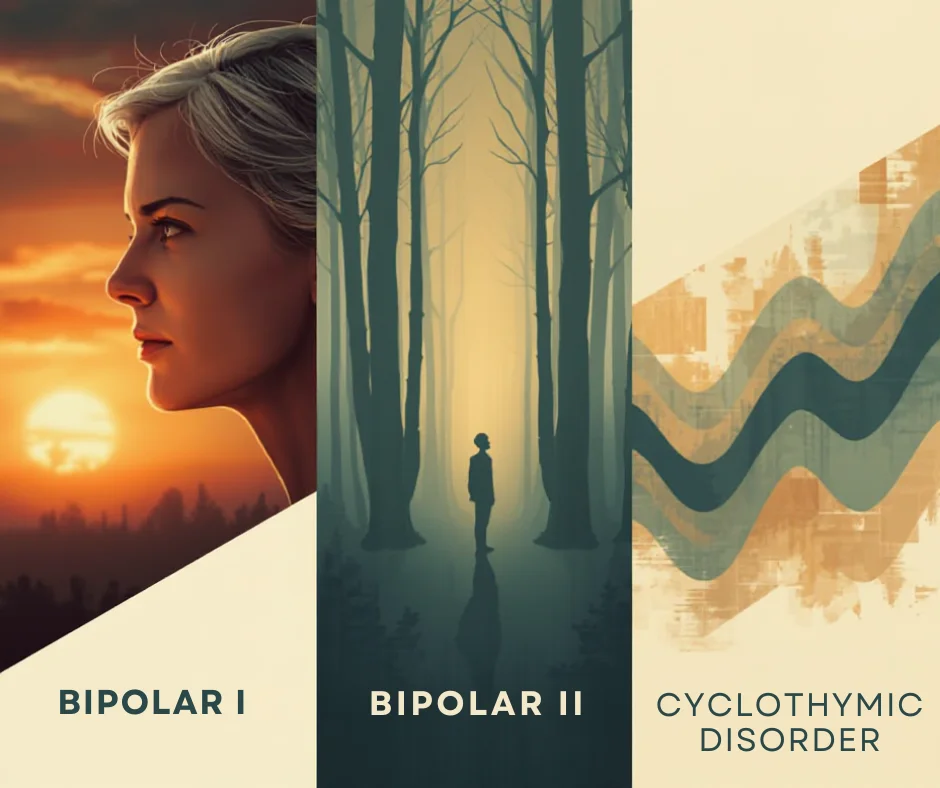
Not all bipolar is “manic elation.” When you take a what type of bipolar disorder do i have quiz, the result usually falls into one of three buckets.
Bipolar I (The Classical Highs)
If you take an am i bipolar quiz and report a week where you didn’t sleep, felt like a genius, and perhaps ended up in the hospital, you likely fit the Bipolar I profile.
Bipolar II (The Productive Highs & Deep Lows)
In a bipolar type 2 quiz, the “up” is called hypomania. You might just feel like a “super version” of yourself—funny, energetic, and productive. However, the do i have bipolar 2 disorder quiz will also ask about the “crash,” which is usually a long, agonizing depression.
Cyclothymic Disorder (The Chronic Rollercoaster)
A cyclothymic disorder quiz or cyclothymia quiz looks for a pattern of “mini-highs” and “mini-lows” that last for at least two years. It’s a milder, but persistent, version of the disorder.
How Bipolar Disorder Is Actually Diagnosed (Not by a Quiz)
If your bipolar disorder quiz free result comes back “High Risk,” don’t panic. This is where the clinical process begins. A quiz is a “snapshot”; a diagnosis is a “documentary.”
- The Clinical Interview: A psychiatrist will walk through your entire life history. They want to know when your first “up” or “down” happened.
- Mood History/Mapping: You may be asked to keep a “Mood Chart” for 30 days.
- Family History: Because bipolar is highly genetic, your doctor will ask about your parents and siblings.
- The DSM-5-TR Criteria: The doctor checks your symptoms against the official “manual” to ensure you meet the legal and medical definition of the disorder.
Bipolar Disorder and Axis I Disorders
In your research, you may see the question, “What Disorders Are in Axis 1?” This is a bit of “old school” psychiatric terminology from the DSM-IV.
- Axis I: Included clinical disorders like Bipolar Disorder, Schizophrenia, and Anxiety.
- Axis II: Included Personality Disorders (like BPD).
While we don’t use the “Axis” system anymore in 2026, it helps to understand that bipolar has always been classified as a Clinical Disorder—meaning it is viewed primarily as a biological illness that can be treated with medication, much like asthma or diabetes.
Conclusion: From the Quiz to the Clinic
A bipolar disorder quiz is a brave first step. It shows that you are paying attention to your mental health and looking for answers. Whether you used a bipolar test idrlabs, a quick bipolar test, or a printable bipolar disorder quiz pdf, the goal is the same: clarity.
If your results suggest you are on the bipolar spectrum, your next step is to schedule an appointment with a mental health professional. Bring your quiz results with you. It simplifies the process and helps your doctor see the patterns you’ve identified. Stability is possible, and it starts with the information you’ve gathered today.
Primary Clinical & Support References
- National Institute of Mental Health (NIMH) – Bipolar Disorder Education
- Depression and Bipolar Support Alliance (DBSA) – Screening Center
- Psychiatry.org (American Psychiatric Association) – Bipolar Guidelines
- International Society for Bipolar Disorders (ISBD) – Global Guidelines
- Mayo Clinic – Bipolar Disorder Diagnosis & Treatment

Related Posts





Subscribe to Our Newsletter
Get mental health tips, updates, and resources delivered to your inbox.
MORE from Author
Read More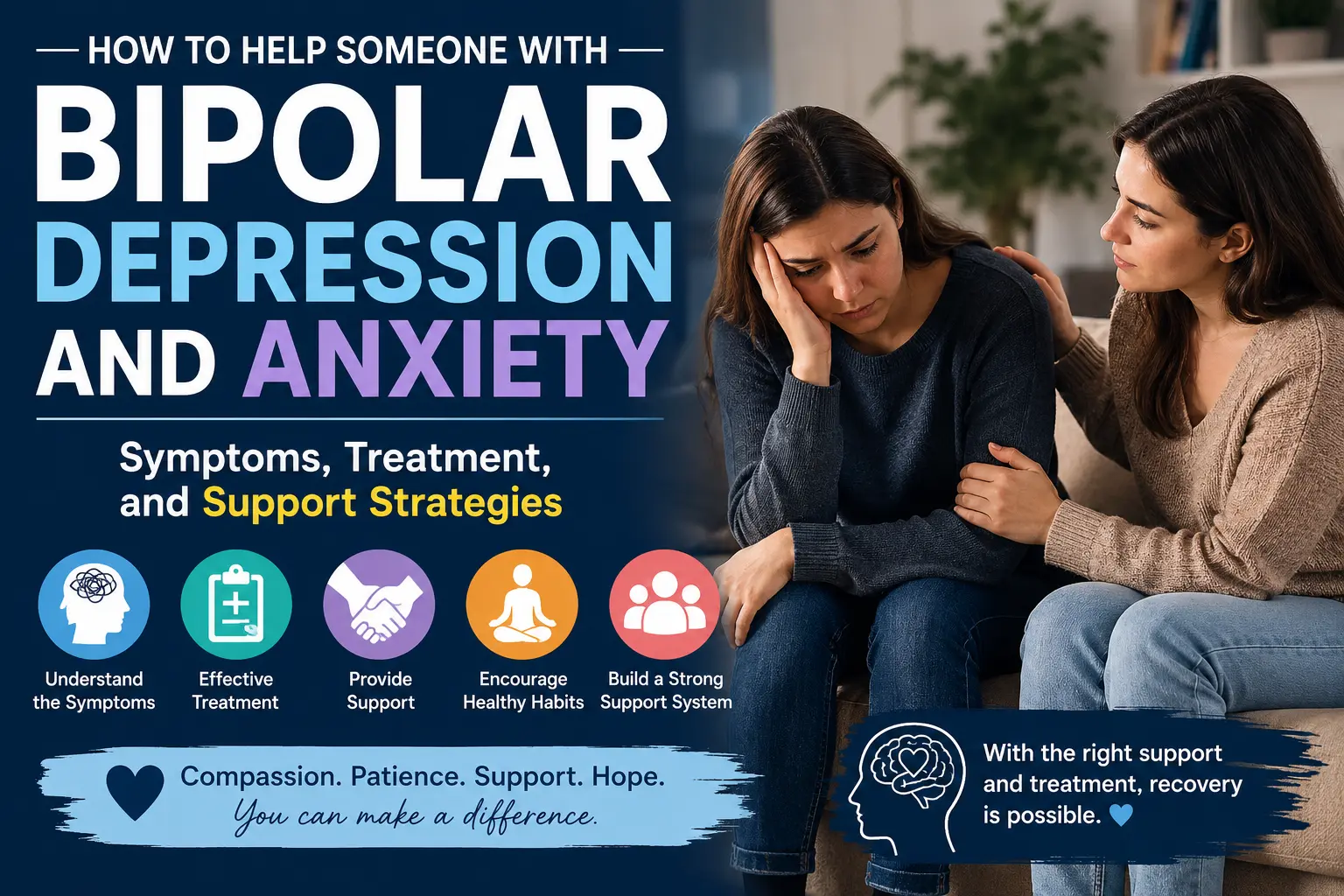 Watching someone you care about struggle with bipolar depression and anxiety can be heartbreaking. You may notice that they withdraw…
 In my practice as a clinical psychologist, I often observe that the difference between a patient who crumbles under pressure…
 We all have "up" days and "down" days. Perhaps you feel energized after a promotion or sluggish on a rainy…
 To define bipolar disorder accurately, we must look at it as a chronic mood dysregulation condition. In psychology and medicine,…
Are you looking for a Therapist?
Connect with qualified mental health professionals who understand
bipolar disorder, mood changes, and emotional challenges.
Private • Supportive • Confidential